
DC60–DC300 range
Five defined output levels use the same platform and scale in 60 kW commercial steps.
DC Fast Charging
Pre-release platform · Project interest open
PlugStream DC is a five-model, liquid-cooled fast-charging platform built around one eight-bay chassis. The product design, model structure, control architecture and guide pricing are defined. We are now registering fleet, public-charging and commercial projects ahead of release.
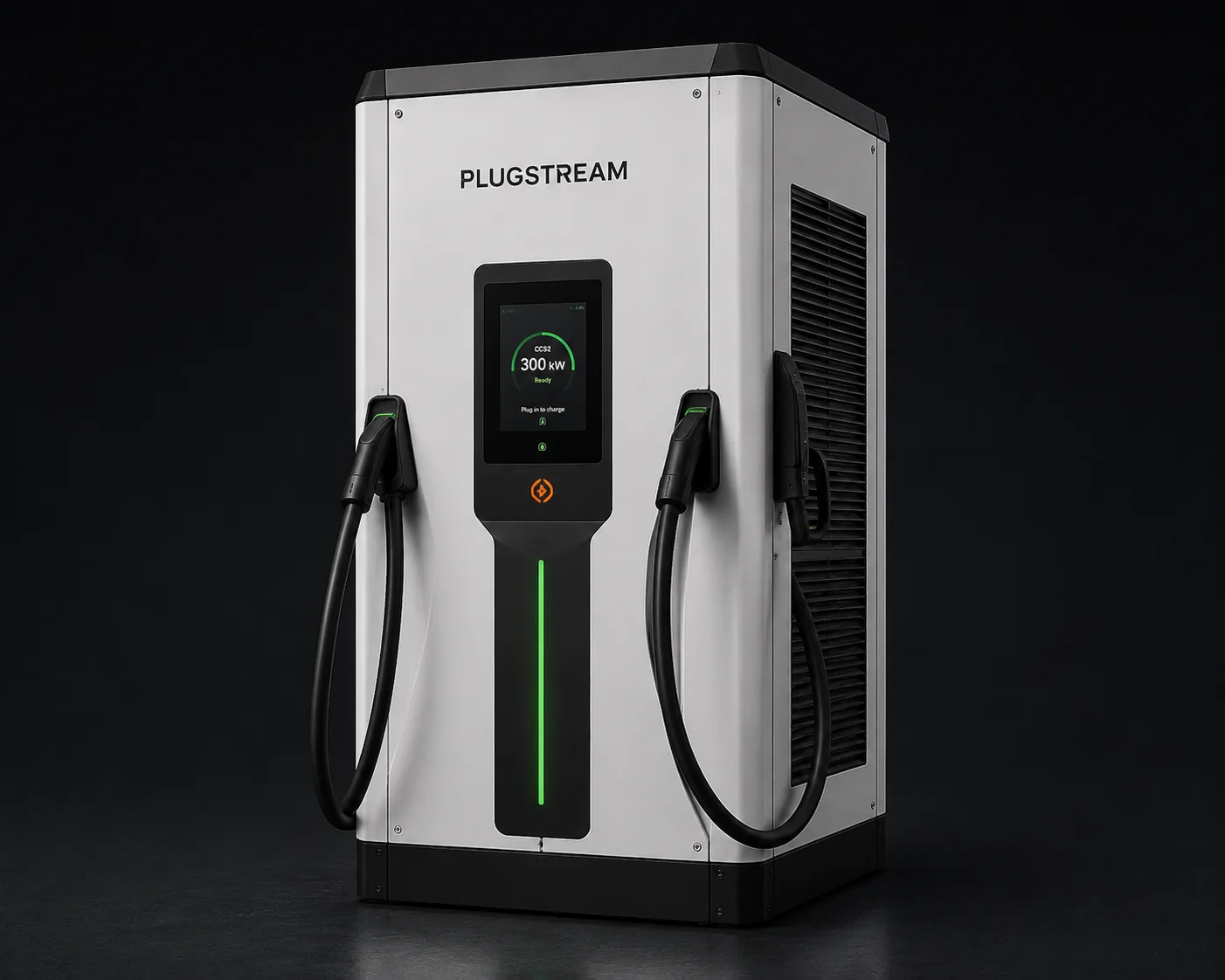
Five defined output levels use the same platform and scale in 60 kW commercial steps.
A monitored closed loop keeps ambient air away from the critical converter electronics.
Six power positions sit alongside dedicated control and independent safety bays.
Populate the sixth power bay so rated output can continue with one converter isolated.
AmpNexus control, Sentinel monitoring and Passport identity are designed into the platform.
Pre-release project programme
PlugStream DC is not yet released for general ordering. This page provides the current design and commercial baseline for operators who want to assess a site, shape a deployment and register early project interest.
The five-model range, chassis layout, converter envelope, liquid-cooling system, control architecture and guide pricing are defined on this page.
Use the published design to assess site power, vehicle duty, resilience, public-charging integration, installation and service requirements.
For each qualified project, PlugStream will confirm site-specific engineering, release timing and the route from registered interest into delivery planning.
Pre-release models and guide pricing
DC60 through DC300 use the same chassis and 60 kW commercial building blocks. The guide prices below cover each standard single-output hardware configuration and are shown ex VAT.
Entry configuration
60 kW
Guide price
£15,995 ex VAT
Two-module configuration
120 kW
Guide price
£21,995 ex VAT
Three-module configuration
180 kW
Guide price
£29,995 ex VAT
Four-module configuration
240 kW
Guide price
£34,995 ex VAT
Five-module configuration
300 kW
Guide price
£39,995 ex VAT
Optional N+1 Resilience Pack
Adds one further liquid-cooled converter module, its protected power branch and coolant connection. The remaining modules can retain the charger’s rated output if one power module is safely isolated.
Match the grid connection
A DC180 can, for example, operate at a 150 kW site limit while retaining its standard three-module hardware. That gives the operator a defined route to use the full model rating when the grid connection or energy strategy changes.
Guide prices establish the charger-hardware baseline. Installation, civils, incoming electrical infrastructure, payment equipment and project-specific service packages are added to the site proposal.
Designed applications
The common DC60–DC300 platform lets project teams match the first installation to the available grid connection, vehicle duty and resilience requirement while retaining a defined expansion path.
Repeatable high-power bays, site-capacity control and module-level service visibility for fleet and depot operations.
Roadside, destination and charging-hub deployments with Luviq operation, payment-terminal and roaming scope added to the project.
Sealed power electronics, monitored liquid cooling and focused module replacement for demanding operating environments.
Coordinate charger output with the available supply, site load-management strategy and future 60 kW expansion steps.
Thermal architecture
DC60 through DC300 use the same monitored liquid-cooling approach. Heat moves to an external heat exchanger while the sealed converter electronics remain isolated from the dust, moisture, salt and roadside contamination around the charger.
Ambient air cools the external heat exchanger instead of being drawn through the power converters, reducing exposure to dust, moisture, salt and roadside contamination.
Removing high-volume ambient airflow through the converter electronics reduces reliance on power-module filters and the routine visits needed to inspect or replace them.
Flow, pressure, temperature, coolant level, pump state and leak detection give Sentinel evidence to identify deterioration and plan work around condition rather than a calendar alone.
Liquid cooling starts with DC60 and scales to DC300, creating a consistent engineering and service approach for roadside, depot, coastal and demanding industrial environments.
Published design baseline
The architecture and values below form the current pre-release design baseline. PlugStream will update this page if product validation materially changes a published value before release.
Each converter can deliver up to 200 A across its 200–1,000 V DC operating range. A DC60 reaches its full 60 kW commercial output at approximately 300 V and above; at lower vehicle voltages, available power follows the voltage-and-current envelope. Higher power models are also governed by the selected CCS2 cable current and the vehicle’s requested voltage.
PlugStream DC
Eight-bay modular chassis concept
One eight-bay chassis
Every DC60–DC300 configuration uses the same vertical chassis architecture. Power modules slide into guided positions while the application-control and safety functions remain separate, replaceable assemblies.
Each 62.5 kW liquid-cooled converter is operated as a 60 kW commercial block. One to five modules create the DC60, DC120, DC180, DC240 and DC300.
Guided rails bring each module to its rear AC, DC, coolant and control interface. There is no redundant enclosure around an already serviceable power module.
The seventh bay runs charge-point applications and connectivity. The eighth bay independently supervises safety, auxiliaries and the decision to energise the vehicle.
The chassis and cooling manifold support six module positions. Add 60 kW blocks as demand grows, while site protection and output hardware are upgraded for the new rating.
Serviceability
Power conversion, application control, deterministic safety and thermal management are separate subsystems. Service work can target the affected assembly instead of replacing or rebuilding the complete charger.
Isolate the affected branch, release the module, disconnect its dry-break coolant interfaces and slide in a replacement without rebuilding the cabinet.
The application controller, charge communication, OCPP client and connectivity live in a separate cassette that can be swapped independently of the high-power assemblies.
The chassis retains its serial, hardware record, configuration, commissioning history and PlugStream Passport identity when a service cassette is replaced.
Connected operations
AmpNexus runs the connected charge point and its OCPP sessions. PlugStream Sentinel records power, cooling, safety and service signals so operators and support teams can see the condition of each charger.
Charger control, OCPP sessions, site-capacity limits, module inventory, software lifecycle and reporting sit within the wider AmpNexus charging estate from commissioning onward.
Sentinel combines live condition signals with configuration, history and service evidence for remote diagnosis, planned intervention and fleet-level reporting.
Monitored evidence
Pre-release commercial scope
The published guide price establishes a comparable hardware baseline across DC60–DC300. The project proposal adds the installation, infrastructure, operating integrations and service package required for the site.
Warranty and lifecycle support
Five-year project cover can add preventive maintenance, response times, spare-module holding, remote support and an agreed on-site service route.
Pre-release questions
Clear answers on release status, the published design baseline, guide pricing, expansion, resilience, warranty and public-charging operation.
The product design baseline is established, but PlugStream DC is not yet released for general ordering. Fleet, public-charging and commercial project teams can use the published specification and guide pricing to register interest now. PlugStream will confirm release timing and the delivery route during project review.
The model, output, module population, N+1 resilience, site power, charging envelope, installation scope, connectivity, payment requirements and service package can all be discussed against the current design baseline.
The guide price covers the standard single-output charger hardware, selected power-module population, liquid thermal management, control and safety cassettes, HMI, RFID, connectivity and three-year standard hardware warranty. Site works and project options are added to the project proposal.
One liquid-cooled converter provides 62.5 kW of physical capacity and is operated as a 60 kW commercial block. Standard products use one to five modules for DC60 through DC300, all within the same eight-bay chassis architecture.
The sixth power bay is populated with an additional converter module. The charger can isolate one failed power module and retain enough conversion capacity to deliver its rated model output through the remaining modules.
Yes. Capacity can be added in 60 kW blocks. PlugStream checks the site supply, protection, AC distribution, DC PDU, cable, cooling configuration and commissioning requirements before carrying out the upgrade.
PlugStream DC includes a three-year standard hardware warranty from first installation. Five-year project cover, preventive maintenance, response-time commitments and spare-module strategies can be included in the project agreement.
AmpNexus provides connected charge-point control and OCPP operations, while PlugStream Sentinel adds condition monitoring and service evidence. Public projects can also be scoped with Luviq network operation, payment terminals and roaming requirements.
Pre-release project interest
Share the site, vehicles, available supply and operating model. We will use the published design baseline to identify the right power level, resilience, connectivity, payment and service scope.
Share the details available now. We will assess the site against the published design, recommend a model and confirm the engineering, commercial and release route for the project.