
Vehicle Wake Assist: helping scheduled EV charging start when the vehicle is asleep
A closer look at the delayed-start moment in overnight and tariff-aware charging
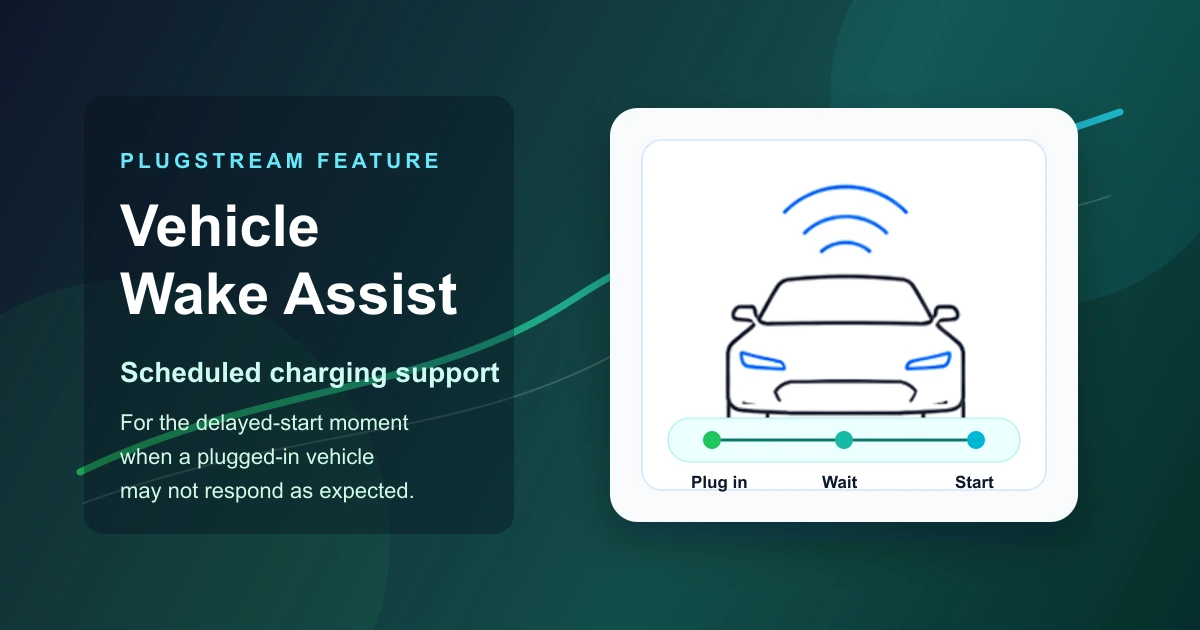
Scheduled charging sounds simple: plug in now, charge later, wake up with the range you expected.
In real life, the delayed-start moment can be more complicated. A charger may be online, a cable may be connected, and a schedule may be waiting for an off-peak window. But when that window opens, some vehicles do not immediately respond. They may have moved into a low-power state, be following their own charging settings, or need more than one prompt before charging starts.
Vehicle Wake Assist is a PlugStream feature designed for that moment. It helps reduce missed scheduled charging windows by checking for sleeping-vehicle behaviour and retrying the charger-side session path where supported.
It does not promise to wake every vehicle in every situation. Vehicle behaviour can vary by manufacturer, model, firmware, settings and charging context. The goal is more practical: give PlugStream a better way to handle a common delayed-charging edge case, and give drivers and support teams clearer signals when charging has not started as expected.
What is Vehicle Wake Assist?
Vehicle Wake Assist helps PlugStream manage the point where a vehicle has been plugged in earlier, then needs to respond later when a saved schedule, smart charging window or tariff-aware charging window begins.
The feature focuses on three things:
- recognising when the charger appears ready but the vehicle is not drawing power
- retrying the charger-side session path where the charger and vehicle support that behaviour
- making the charging state easier to understand for the customer, installer or support team
That distinction matters. A missed charging window is not always a charger fault. Sometimes the charger is waiting correctly, but the vehicle is not ready to accept energy at the moment the session should begin.
Why can scheduled EV charging fail to start?
Delayed charging introduces a gap between plugging in and starting the session. During that gap, several things can change.
The vehicle may enter a sleep or energy-saving state. The vehicle may also have its own departure schedule, charging limit, app setting or battery protection behaviour. On the charger side, a saved schedule, smart charging random delay, load-management condition or connectivity issue can also affect the session.
That is why a useful charging experience needs more than a basic connected or disconnected status. It needs context.
For example:
- Waiting for schedule means the charger is deliberately holding the session until the planned window.
- Waiting for vehicle means the charger is ready, but the vehicle is not yet requesting energy.
- Charging paused can be expected if load management or site power conditions are temporarily holding the session.
- Offline means app control and support visibility may be limited until the charger checks in again.
Charger Readiness helps explain those charger-side states. Vehicle Wake Assist focuses more narrowly on the delayed-start handover when the charger is ready to begin but the vehicle may not respond as expected.
What Vehicle Wake Assist can and cannot do
Vehicle Wake Assist can improve the charger-side handling of supported delayed-start scenarios. It can help PlugStream recheck the session path, retry where appropriate, and make it easier to distinguish a charger readiness issue from vehicle response behaviour.
Vehicle Wake Assist cannot override every vehicle sleep state, change vehicle firmware, bypass vehicle settings, fix a loose cable, or solve a site power or connectivity problem. It is a resilience feature, not a universal guarantee.
That is the right kind of promise for EV charging. The system should be more helpful without pretending that a charger controls every part of the vehicle.
How Vehicle Wake Assist works with Charger Readiness
The two features are strongest together.
Charger Readiness gives the customer and support team a clearer answer to the question: is the charger ready for the next charging window?
Vehicle Wake Assist supports the next question: when the window starts, is the vehicle responding as expected?
Together, they help make the charging journey easier to understand:
- The customer plugs in before the planned window.
- The charger waits for the saved schedule, smart charging mode or tariff-aware instruction.
- Charger Readiness helps explain whether the charger is ready, waiting, paused, offline or asking for attention.
- When the planned window starts, Vehicle Wake Assist checks the vehicle response and retries the charger-side session path where supported.
- If charging still cannot begin, the app and support conversation have a clearer starting point.
For drivers, that means fewer vague "why did it not charge?" moments. For installers and support teams, it means less guesswork when a delayed session does not behave as expected.
Why this matters for overnight and off-peak charging
Vehicle Wake Assist is especially useful when charging is intentionally delayed.
That can include a customer using a cheaper overnight window, a saved home charging schedule, a vehicle departure plan, or a site where vehicles are plugged in between shifts. In each case, the customer expectation is the same: the charger should wait, then start at the right time.
When the vehicle does not respond at that moment, the customer may not notice until the morning or before the next journey. A better delayed-start handover reduces that risk where supported, and gives PlugStream a clearer route for support if the vehicle still does not take energy.
What drivers should check first
If a scheduled charge does not start, the first checks should stay simple:
- confirm the cable is fully connected at the vehicle and charger
- check the charger is online in MyPlugStream
- review any saved charger schedule or smart charging mode
- check the vehicle's own charging limit, departure schedule and app settings
- look for load-management or site power conditions that may be pausing the session
If the charger looks ready but the vehicle is still not requesting energy, Vehicle Wake Assist gives PlugStream a more useful way to handle that handover where the scenario is supported.
Explore the feature
You can read the feature overview here: Vehicle Wake Assist.
To understand the wider charging-state picture, start with the EV charging features guide, Charger Readiness, and the product update on Charger Readiness in MyPlugStream.
For a support-style explanation of the charger and vehicle handover, read Waiting for vehicle: what your EV charger can and cannot control.
For a behind-the-scenes look at how PlugStream runs automated 24/7 charging-state and delayed-session scenarios against real hardware, read How automated hardware-in-the-loop testing helps PlugStream build more reliable EV charging features.
FAQ
Vehicle Wake Assist questions
Can Vehicle Wake Assist wake every vehicle?
No. Vehicle behaviour varies by manufacturer, model, firmware and settings. Vehicle Wake Assist improves the charger-side handling where supported, but it cannot override every vehicle sleep state.
Does Vehicle Wake Assist replace scheduled charging?
No. It complements scheduled charging. The schedule still defines when charging should begin. Vehicle Wake Assist helps with the moment the delayed session is expected to start.
Is this only useful for home charging?
No. It is relevant anywhere vehicles may sit plugged in before charging begins, including homes, workplaces, fleet settings and other managed charging sites.
Is Vehicle Wake Assist the same as Charger Readiness?
No. Charger Readiness focuses on whether the charger looks ready for the next session. Vehicle Wake Assist focuses on vehicle response when a delayed session starts.
Explore More
Compare the PlugStream range
See how PlugStream 7S, PlugStream 7T, and the PlugStream 22 family fit different homes, commercial sites, and daily charging routines.