
EV charger load management: why charging can pause or slow down
Why a charger may reduce output when the wider property or site needs capacity
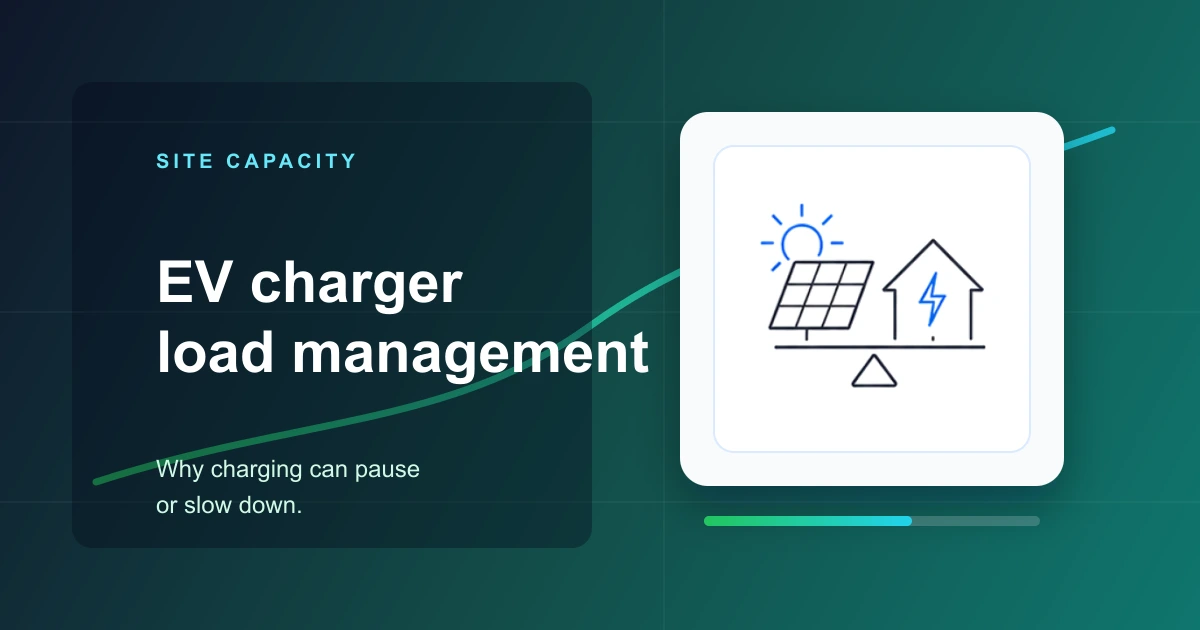
An EV charger does not work in isolation. It shares an electrical supply with the wider home, workplace or commercial site.
Load management is the feature area that helps charging respond to available capacity. Sometimes that means charging more slowly. Sometimes it means pausing until the site has capacity again.
Quick answer: why does load management pause EV charging?
EV charger load management can pause or slow charging when the wider property or site is using available electrical capacity elsewhere. The charger may be protecting the supply or following a site control signal rather than failing to charge.
That distinction matters. A paused session can be expected behaviour.
What load management is trying to protect
Load management helps avoid asking the electrical supply to do more than it has been designed or configured to do.
In a home, that might mean balancing EV charging against the wider household load. In a commercial site, it might mean sharing capacity across several bays, reacting to live site readings, or staying within the limits of the agreed installation design.
The customer outcome should be simple: charge where practical without making the wider site harder to manage.
Why charging can slow down
Charging can slow down when the charger receives or calculates that less capacity is available.
Common reasons include:
- other large loads using power at the same time
- a site limit or load-management setting reducing the available current
- several chargers sharing capacity across the same supply
- missing or delayed site telemetry
- a configured charge limit or operating mode
Slower charging is not always a problem. It may be the system doing its job.
Why charging can pause
Charging can pause if available capacity is too low or if the charger is waiting for the information it needs to continue safely.
For the customer, the important thing is the status message. "Paused by site power conditions" is much more useful than a generic "not charging" state.
Charger Readiness helps make these charger-side signals clearer so customers and support teams can separate expected load-management behaviour from issues that need action.
Load management at home and on commercial sites
At home, load management can support a more practical charging routine around the wider property demand.
On commercial sites, it becomes more operational. Workplaces, depots, shared parking and hospitality sites often need chargers to fit within the site supply and the expected operating model.
For commercial planning, start with Commercial charging. For managed support and monitoring across installed estates, review PlugStream Sentinel.
What drivers and site teams should check
When charging is paused or slower than expected, check:
- whether the app shows a load-management or site power message
- whether the charger is waiting for live site telemetry
- whether several chargers are using the same supply
- whether other property loads are active
- whether the charging schedule or tariff window has changed
- whether the vehicle is still requesting energy
If the charger is load-limited, changing the vehicle settings may not solve the issue. The constraint may be site-side.
How load management fits with scheduled charging
Scheduled charging decides when charging should happen. Load management affects how much capacity is available when that window arrives.
A charger can be correctly waiting for an off-peak window, then correctly pause because the site has limited capacity at that moment. Both can be true in the same session.
Read the related guides: Scheduled EV charging not starting and Smart tariff EV charging.
Related PlugStream guidance
Start with the wider cluster: EV charging features guide.
Then review Charger Readiness, Home charging, Commercial charging and PlugStream Sentinel depending on whether the question is about a single charger or a managed charging site.
Explore More
Compare the PlugStream range
See how PlugStream 7S, PlugStream 7T, and the PlugStream 22 family fit different homes, commercial sites, and daily charging routines.