
Socketed or tethered EV charger: which should you choose?
Cable flexibility or everyday convenience: how to decide between PlugStream 7S and PlugStream 7T
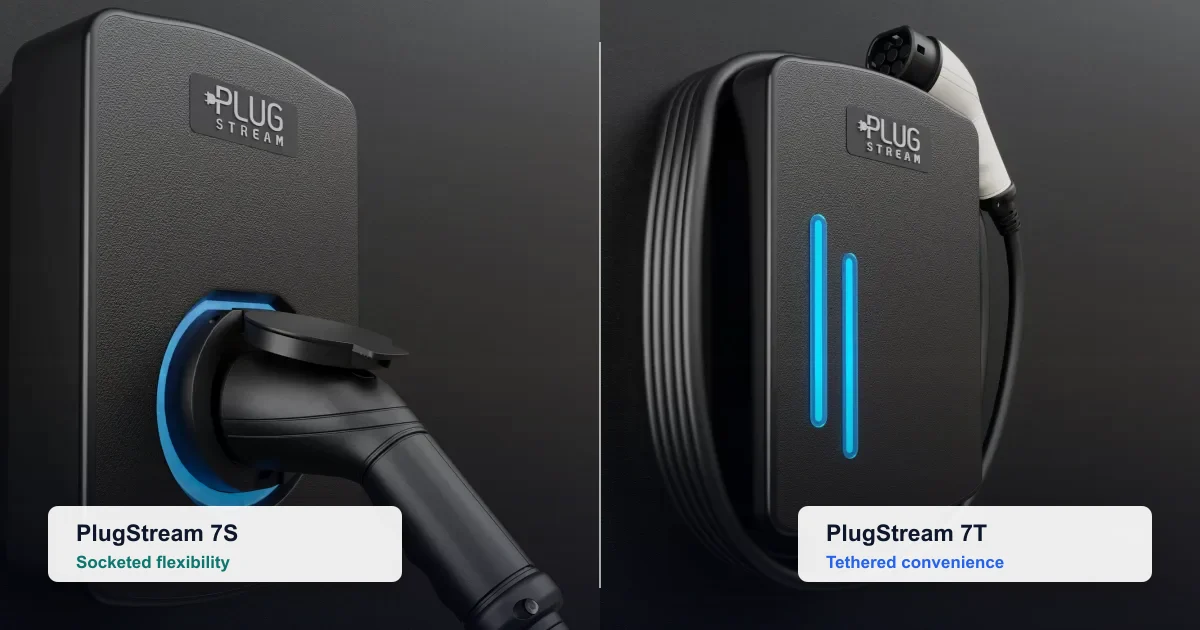
One of the simplest questions in home EV charging can be surprisingly hard to answer: should I choose a socketed charger or a tethered charger?
The honest answer is that neither format is automatically better. The right choice depends on how the parking bay will be used, who will plug in, and how much you value cable flexibility versus daily convenience.
For the PlugStream 7 family, the choice is between PlugStream 7S, our socketed 7.4kW smart charger, and PlugStream 7T, our tethered 7.4kW smart charger with an integrated 7m Type 2 cable. Both sit on the same PlugStream platform, so the decision is mainly about the way you want to use the charger day to day.
The quick answer
| Choose a socketed charger if... | Choose a tethered charger if... |
|---|---|
| More than one driver may use the charger. | The same driver uses the same bay most days. |
| You want to use different cable lengths over time. | You want the cable ready every time you park. |
| Visitors or shared parking users may need the bay. | You want the fastest plug-in routine. |
| You prefer a tidier look when the charger is not in use. | You do not want to get a cable out of the boot. |
| You want maximum flexibility for future vehicle changes. | You are happy with a permanently attached Type 2 lead. |
Put another way: socketed is about flexibility; tethered is about convenience.
What is a socketed charger?
A socketed charger has a Type 2 socket on the front of the unit. You plug a separate charging cable into the charger, then into the vehicle.
That makes a socketed charger a strong fit when the bay may serve different drivers, different vehicles, or changing routines. It is also useful if you want the charger to look cleaner between charging sessions because there is no permanently attached cable on show.
For PlugStream, that product path is PlugStream 7S.
Why choose socketed?
Choose socketed if the charger needs to stay adaptable.
That might mean a shared driveway, apartment parking bay, visitor space, workplace bay, or a home where vehicle needs may change over time. Drivers can bring the cable that suits their vehicle and parking position, and the site is not tied to one fixed lead length.
Socketed can also be a neat option for properties where the charger is highly visible from the front of the home. When charging finishes, the cable can be removed and stored separately.
The trade-off is that the cable is another item to handle. You may need to get it out of the boot, coil it away afterwards, or deal with it when it is wet or dirty.
What is a tethered charger?
A tethered charger has the charging cable permanently attached to the unit. With PlugStream 7T, that means an integrated 7m Type 2 cable ready at the charge point.
For many home drivers, this is the easiest day-to-day setup. You park, pick up the connector, plug in, and let the charger follow the schedule or charging mode you have set.
For PlugStream, that product path is PlugStream 7T.
Why choose tethered?
Choose tethered if the charger is mainly for one dedicated parking bay and one regular charging routine.
The biggest benefit is convenience. There is no separate cable to fetch, no repeated unpacking, and less friction when you get home late or leave early. If you charge several times a week, those small moments add up.
Tethered can also help keep the correct cable at the bay. That is useful for a dedicated home install where the same driver wants the charger ready every day.
The trade-off is visual and practical flexibility. The cable is always part of the installation, so cable management matters. It is also less adaptable if the bay is used by different drivers who may prefer different cable lengths or arrangements.
What stays the same?
With PlugStream 7S and PlugStream 7T, the charger format changes, but the platform does not.
Both models offer:
- 7.4kW single-phase AC charging
- app control and session visibility
- smart tariff scheduling
- solar-aware charging support
- automatic load management
- over-the-air software updates
- OCPP-ready software flexibility
- the same PlugStream 7 face plate colour palette
So you do not need to choose between smart features and cable format. You are choosing the charging routine that fits the property.
A few practical examples
If you have a single driveway bay used by the same EV every day, tethered is usually the easiest recommendation. The charger is always ready, and the charging lead lives exactly where it is needed.
If you have a shared bay, visitor space, or changing vehicle mix, socketed usually makes more sense. The charger stays flexible, and each driver can use the cable that suits them.
If you care most about a minimal look when the charger is idle, socketed has the advantage because the cable can be removed.
If you care most about speed and simplicity when plugging in, tethered has the advantage because the cable is already there.
Which PlugStream model should I choose?
Choose PlugStream 7S if you want a socketed charger for flexible cable choice, shared-use parking, visitor charging, or a cleaner finish between sessions.
Choose PlugStream 7T if you want a tethered charger for a dedicated home bay, a predictable daily routine, and the quickest plug-in experience.
If you are still weighing up the two options, start with the PlugStream 7 family comparison, or contact the PlugStream team for help matching the charger format to the site.
Explore More
Compare the PlugStream range
See how PlugStream 7S, PlugStream 7T, and the PlugStream 22 family fit different homes, commercial sites, and daily charging routines.